How to visit My Son Sanctuary from Da Nang: ticket prices, opening hours, the Cham dance show, getting there by Grab, car or tour, and the best time to go.

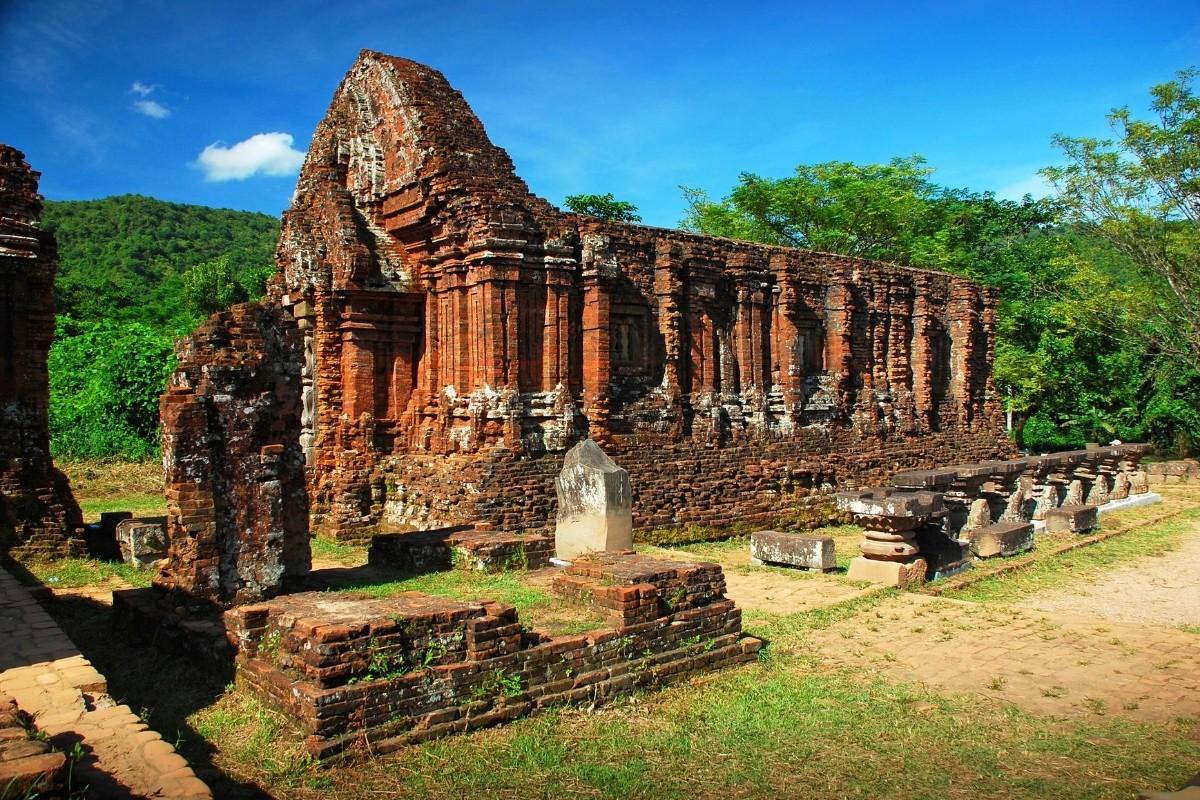
Tucked into a jungle valley 40 km southwest of Da Nang, My Son Sanctuary is a cluster of ancient Hindu temple ruins built by the Cham civilization between the 4th and 13th centuries. This UNESCO World Heritage Site is well worth a half-day trip if you love history, but you will want to arrive early to beat the midday heat and heavy crowds.
By the Go-Da-Nang local team · Last updated June 2026
My Son (pronounced "mee sun") was the spiritual and political heart of the Champa Kingdom. This Hindu-influenced civilization ruled central Vietnam for well over a thousand years. Starting around the 4th century, Cham kings built brick towers here to worship Shiva. Successive dynasties expanded the site right up until the 13th century. At its peak, roughly 70 temples and tombs filled this single valley.
The setting adds a lot to the experience. The temples sit in a lush bowl ringed by jungle-covered mountains. Cat's Tooth Mountain (Hòn Quắp) watches over the valley and was considered sacred by the Cham people. The towers feature fired red brick fitted together so precisely that the joints are almost invisible. You will also see carved sandstone lintels and reliefs of dancers, deities, and animals.
My Son became a UNESCO World Heritage Site in 1999. Expect heavily weathered ruins rather than a fully intact temple city. Much of the damage happened in 1969 when US bombing destroyed several major towers, including the masterpiece Group A temple. Today you will find a mix of standing brick towers, partly collapsed structures, foundations, and carved fragments undergoing conservation. That half-reclaimed-by-the-jungle atmosphere is exactly why people visit.
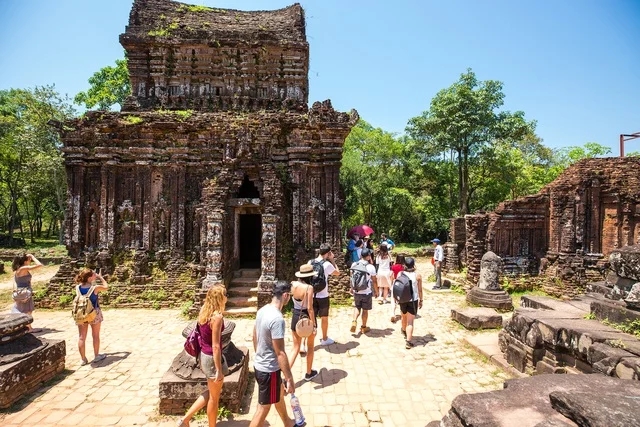 Weathered Cham brick towers among greenery, central Vietnam
Short answer: yes. My Son is the best place in central Vietnam to understand the Cham culture you see hints of throughout Da Nang, including at the Museum of Cham Sculpture. You will enjoy this trip if you like history, ancient architecture, photography, or atmospheric old stones in a beautiful setting.
Who will love it:
Who might skip it:
The two main downsides are the heat and the crowds. The valley lacks shade and gets brutally hot by late morning. Big tour buses from Da Nang and Hoi An arrive in a wave around 9:00 to 10:00 am. They quickly fill the best-preserved temple groups with large crowds. The easy fix is to arrive for the 7:30 am opening or visit in the late afternoon after the buses leave.
My Son is roughly 40 to 45 km southwest of central Da Nang. The drive takes about an hour each way depending on traffic. No public bus goes all the way to the gate. Your realistic options are a private car, a Grab or taxi, your own motorbike, or an organized tour.
| Option | Approx cost | Drive time (each way) | Best for |
|---|---|---|---|
| Private car / driver | ~600,000–900,000đ round trip (with wait) | ~1 hr | Families, comfort, flexible timing |
| Grab / taxi | ~400,000–500,000đ one way | ~1 hr | Couples, no wait-time needed |
| Motorbike | Rental ~150,000–300,000đ/day + fuel | ~1.25 hrs | Confident riders, independence |
| Organized tour | From ~300,000đ/person (group) | ~1 hr (in a group) | First-timers, no planning, a guide |
A private car is the easiest and most comfortable option for families or small groups. Your hotel or a ride-hailing app can arrange a driver to wait while you explore. Expect to pay around 600,000 to 900,000đ for a round trip with a couple of hours of waiting time included. Agree on the price, the waiting arrangement, and toll or parking inclusions before you leave. This is the best choice for a dawn visit to beat the buses.
A Grab car or taxi from central Da Nang to My Son costs roughly 400,000 to 500,000đ one way. The catch is the return trip. My Son is remote, cell signal is patchy, and you will likely struggle to book a Grab back from the gate. You should either ask your outbound driver to wait for a negotiated round-trip fare or have your hotel pre-book a return pickup for a set time.
Confident riders will enjoy the trip out. The simplest route is to head south on Highway 1 toward Nam Phước, then turn west and follow the signs for Duy Xuyên and My Son (Mỹ Sơn). Allow a bit over an hour for the 40-plus km ride. The final stretch winds through scenic rice paddies and small villages. You will find a paid motorbike parking area near the entrance for a small fee (around 5,000 to 10,000đ). Bring rain gear in the wet season and avoid riding in heavy rain because rural roads get very slick.
Half-day and full-day tours leave from Da Nang and Hoi An daily. They usually include round-trip transport and a guide to explain the history. Prices start around 300,000đ per person for a basic group tour and increase for small-group, private, or sunrise options. Many group tours arrive mid-morning right at peak crowd times. Look specifically for a sunrise tour that gets you to the gate near opening time.
The entrance fee at My Son is 150,000đ for foreign adults and 50,000đ for foreign children aged 5 to 15. Vietnamese visitors pay 100,000đ (adults) and 30,000đ (children 5 to 15), and kids under 5 go free. You buy tickets at the main entrance gate before heading to the ruins.
The site is open daily from 7:30 am to 5:30 pm (07:30 to 17:30). Last entry is just before closing, so plan accordingly for late-afternoon visits.
Your ticket includes two great perks. You get a ride on the electric shuttle buggy from the entrance area (near Khe Thẻ bridge) to the start of the temple zone, and you get entry to the Cham (Apsara) dance performance near the entrance. The shuttle saves you a hot 1 to 2 km walk along an exposed road. Take it in both directions.
The live Cham Apsara dance show takes place in a small theater pavilion near the entrance. This 20 to 30 minute program features traditional Cham music, graceful Apsara celestial dancer movements, trống Paranưng drums, and sometimes a water-jar balancing act. It offers a well-staged look at living Cham culture.
Shows run several times a day, roughly between 9:00 am and 11:30 am and again in the mid-afternoon (commonly cited slots include around 9:30 am, 10:45 am, 2:30 pm, and 3:30 pm). Exact times shift seasonally and are subject to change, so check the board at the entrance when you arrive and plan your temple walk to finish near the theater. If you arrive at the 7:30 am opening, explore the ruins first while it is cool and catch the mid-morning performance on your way out.
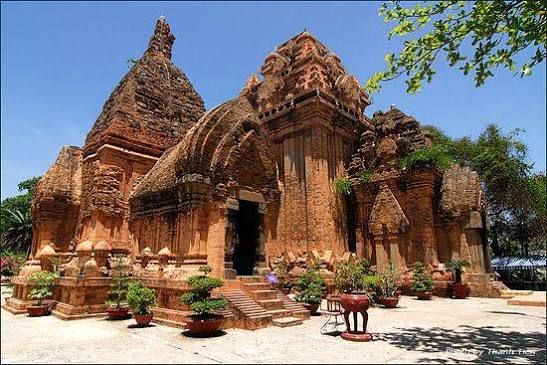 Detailed sandstone relief and brickwork on an ancient Cham tower
The temples are organized into lettered groups from A through H scattered across the valley. Several are just foundations today. Knowing where to spend your time helps you manage the heat.
These are the best-preserved and most rewarding clusters. They sit close together at the heart of the site. Group B and C feature some of the finest surviving brick towers and carved details. Group D holds two long hall buildings now used as small on-site display areas. You can see original sandstone reliefs, altars, and statuary up close here. Prioritize B, C, and D on a short visit to see the best Cham craftsmanship.
Group A was historically the masterpiece of My Son. Its great tower was among the tallest and most ornate in the Cham world before being destroyed by bombing in 1969. Today it is largely ruins with ongoing restoration work. Groups E and F show older architectural styles and are partly collapsed. Groups G and H sit further out and highlight recent Italian-led and UNESCO conservation work. Walk through A on your way between clusters and treat E through H as a bonus if you have the energy.
Suggested walking loop: Take the shuttle in and start at the main B, C, and D cluster while it is quiet and cool. Loop out to Group A and the nearby groups, then circle back toward the entrance for the Cham dance show and the shuttle out. Take your time to look closely at the detailed reliefs.
Arrive at the 7:30 am opening. You will have the ruins almost to yourself in soft light that is great for photos. Most importantly, this is the only cool part of the day. The valley has almost no shade. By 10:00 am it gets hot and busy as the tour buses arrive. The next-best window is late afternoon from about 3:00 pm once the bus groups head back.
The dry season from roughly February to August is the most reliable time for a comfortable visit. March through May offers green surroundings before the peak summer heat hits. The rainy months around September to December bring downpours and muddy paths, but the valley looks incredibly lush and the misty mornings feel very atmospheric. Early morning is always the best choice regardless of the season.
Plan on 1.5 to 2.5 hours on site. This gives you enough time to ride the shuttle, walk the main groups, catch the dance show, and leave before the worst heat. Add the round-trip drive to make this a comfortable half-day trip from Da Nang. You can leave around 6:30 am and be back by lunchtime. Many people choose to extend the trip into a full day by pairing it with Hoi An.
My Son and Hoi An make a natural full-day pairing. My Son sits inland southwest of Da Nang, while Hoi An is on the coast to the southeast, so the two combine easily into a loop rather than a there-and-back. The best approach is My Son in the morning followed by Hoi An in the afternoon and evening.
Explore My Son at the quiet opening time, then drive about 45 minutes to an hour to Hoi An. Grab lunch, walk the Old Town in the afternoon, and stay to see the lanterns after dark. If you want to time your visit with the lantern nights, check our guide to Hoi An's 2026 festivals and lantern dates to find a full-moon evening. For transport details, read how to get from Da Nang to Hoi An.
This day trip fits perfectly into a longer stay. Both our 7-day first-timer's week and the perfect 5-day Da Nang itinerary include a combined My Son and Hoi An day. If you are short on time, the 3-day Da Nang itinerary explains how to prioritize your stops.
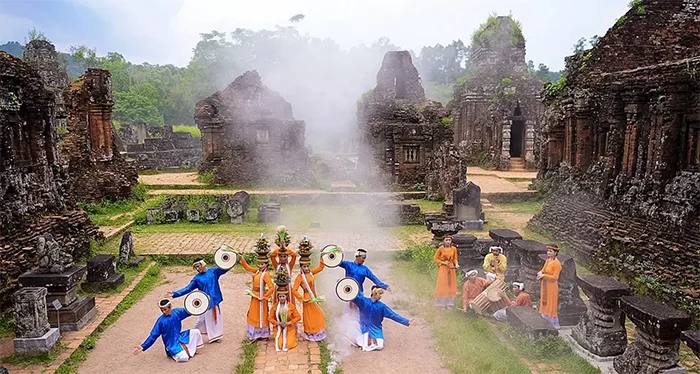 Traditional Cham Apsara dance performed for visitors at My Son
For more ideas on filling your itinerary, see our local's guide to things to do in Da Nang.
How much is the entrance fee? 150,000đ for foreign adults and 50,000đ for foreign children (5 to 15); Vietnamese visitors pay 100,000đ (adults) and 30,000đ (children). The ticket includes the electric shuttle and the Cham dance show.
How far is My Son and how long is the drive? It is about 40 to 45 km southwest of central Da Nang. The drive takes roughly one hour each way.
Is it worth it, or should I just do Hoi An? It is highly recommended if you like history and ruins. You can easily do both in one day. If ancient ruins do not interest you, spending the whole day in Hoi An is a great alternative.
Can you do My Son and Hoi An in one day? Yes. This is a very popular combination. Visit My Son at the morning opening, then spend the afternoon and evening in Hoi An. The two sites are about 45 minutes to an hour apart.
What time should I go to avoid the heat and crowds? Arrive at the 7:30 am opening. You get cool air, soft light, and near-empty temples before the tour buses arrive around 9:00 am. Late afternoon after 3:00 pm is the second-best option.
Is the dance show included in the ticket? Yes. The Cham Apsara performance near the entrance is included in your standard ticket. Check the daily show times on the board when you arrive, as they shift seasonally; they generally run a few times in the morning and once or twice in the mid-afternoon.
Do I need a guide? A guide is highly recommended. On-site signage is limited and the Cham history is unfamiliar to most visitors. A good guide turns a walk past old bricks into a much deeper experience.
My Son Sanctuary is a highly rewarding half-day trip from Da Nang for anyone curious about Vietnam's ancient history. Arrive at the 7:30 am opening to beat the heat and the crowds. Take advantage of the included shuttle and dance show, spend two unhurried hours exploring the brick towers, and consider stopping in Hoi An on your way back. Pack water, wear a hat, bring some small cash, and enjoy the quiet morning atmosphere in the valley.

One local roundup a month — new guides, festival dates and where to eat. No spam.