Where did cao lầu come from? The history, the name, the Japanese and Chinese theories, and why locals say it can only be made in Hội An.

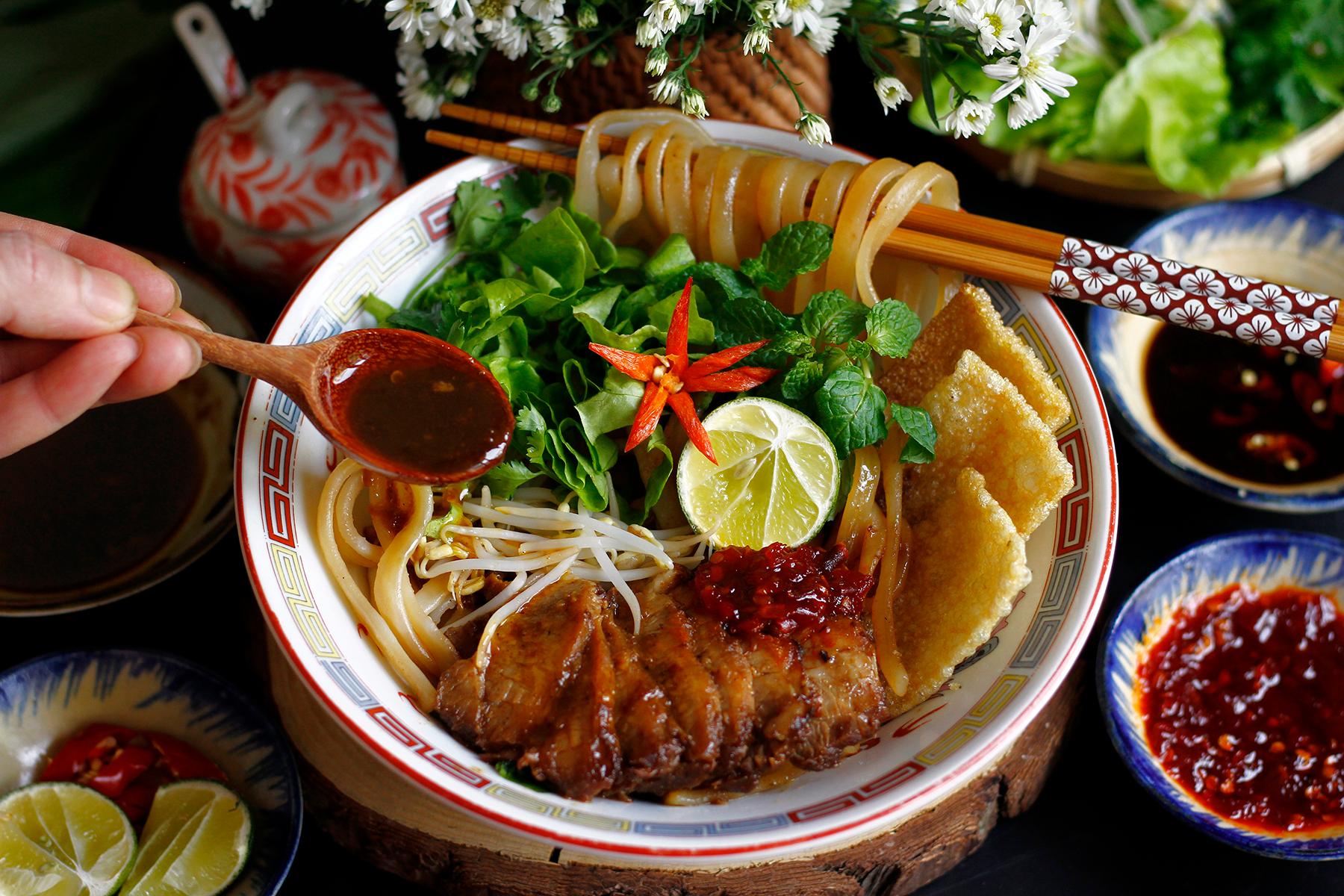
Cao lầu is a thick, brothless noodle dish from Hội An, the ancient trading port 30 minutes south of Da Nang. Nobody knows exactly who invented it, but the bowl holds a 400-year-old story of foreign merchants, an ancient well, and ash from a nearby island.
By the go-danang team. Last updated June 2026.
This piece covers the history and the legends. If you just want to know what is in the bowl and where to eat a good one, start with our cao lầu guide and come back here for the backstory later.
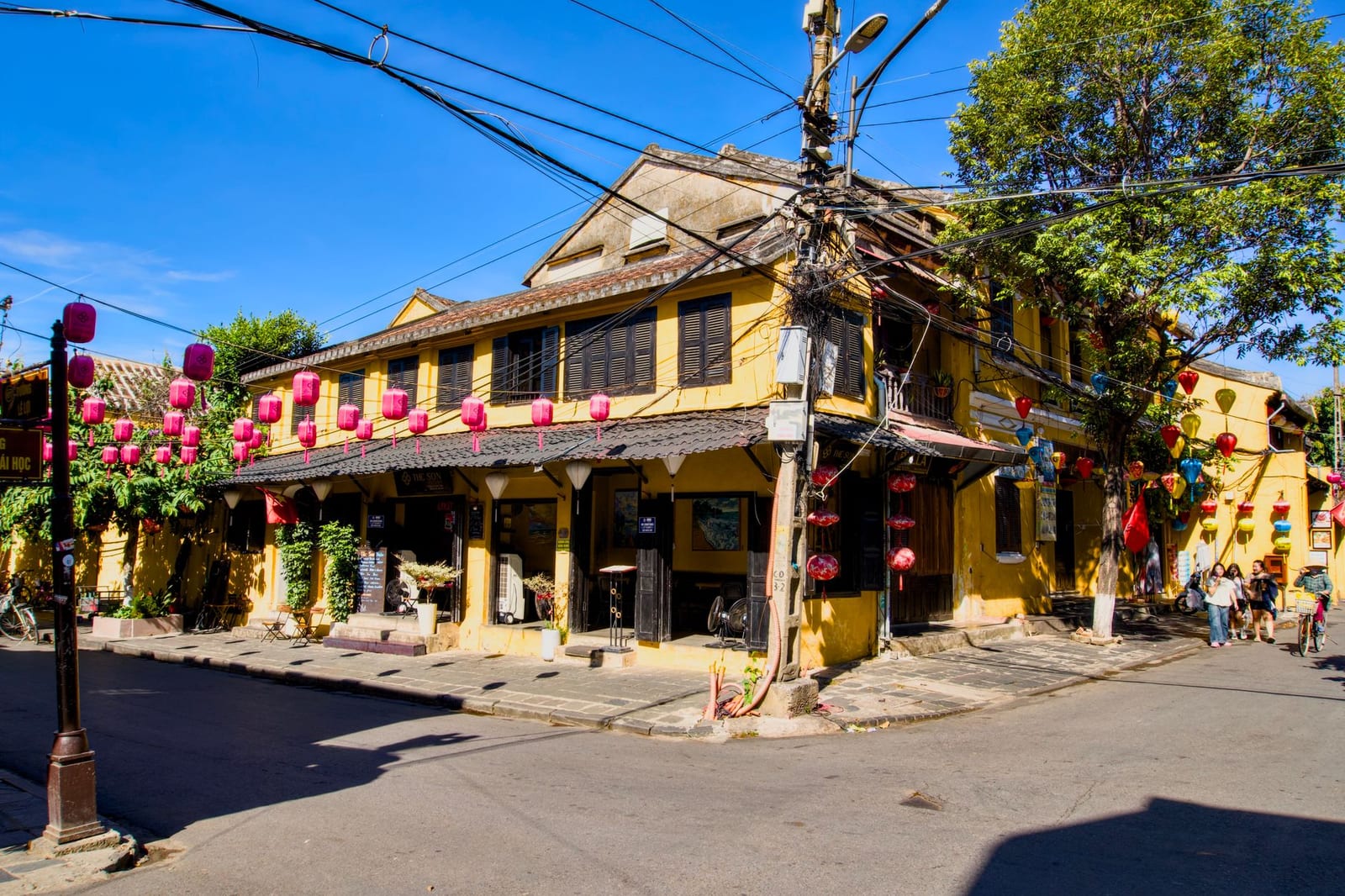 A lantern-lit street in Hội An's Old Town, the centuries-old trading port where cao lầu was born.
The name is the first clue to the dish's origin. "Cao lầu" is usually traced to Chinese, where "cao" means high and "lầu" means floor or upper storey, so the phrase reads roughly as "high floor" or "upstairs."
According to the usual explanation, well-off merchants in old Hội An climbed to the upper floors of riverside shophouses and eateries to eat. Up there they could catch the river breeze, keep an eye on their goods below, and watch the street. The dish, the story goes, took its name from where it was eaten.
This detail tells you something important right away. The dish grew up in a busy port and was shaped by many hands. This leads to the real question of where this udon-like, brothless noodle actually came from.
To understand cao lầu, you have to picture Hội An 400 years ago. In the 16th and 17th centuries, under the Nguyễn lords, it was one of the busiest international trading ports in Southeast Asia. Ships arrived from Japan, China, the Netherlands, Portugal, and India to trade silk, ceramics, spices, and medicine.
Hội An was divided into several quarters living side by side. A Japanese quarter and a Chinese quarter sat on either side of a stream linked by the famous Japanese Covered Bridge (Chùa Cầu), built around the turn of the 17th century and still standing today. The Japanese community thinned out after Japan's government closed the country to most foreign trade in the 1630s, while Chinese merchants from Fujian stayed and grew for far longer.
When you eat cao lầu, you are tasting the history of a port. Because so many cultures passed through, there is no single inventor to point to. That is exactly why there are several competing legends.
None of these theories is fully proven because old food rarely leaves paperwork. However, each theory points to something you can still taste or see in the bowl today. Here is the honest summary, followed by a closer look at each.
| Theory | What it claims | What you can see in the bowl today | How solid |
|---|---|---|---|
| Chinese / Fujian | Brought by Fujian Chinese traders | Char siu pork, soy seasoning, dry-tossed (no broth) | Strongest |
| Japanese udon | Inspired by Japanese udon noodles | Thick, square, chewy noodle | Circumstantial |
| Champa / Cham | Predates the traders; tied to old Cham wells | The ancient Bá Lễ well | Weakest / mostly oral |
| Local terroir | It is the place, not a people | Hội An's well water and island ash | Partly testable |
This theory leaves the clearest fingerprint. Look at the toppings. You will find char siu (Cantonese-style roast pork, called xá xíu here), a soy-based seasoning instead of fish sauce, and a barely-there sauce you toss the noodles in rather than a soup you slurp. All three feel Chinese rather than classically Vietnamese.
Fujian Chinese traders were the largest and longest-staying foreign community in Hội An. Their food shaped the local kitchen in many ways. Of the four theories, this is the best documented. If forced to pick one origin, the seasoning of cao lầu points straight here.
Now look at the noodle itself. It is thick, square-cut, pale, and very chewy. It is denser and firmer than any other Vietnamese noodle. To many people it looks and bites like Japanese udon, and the comparison most often drawn is to Ise udon, a thick, soft noodle from Mie Prefecture that is dressed in a small amount of dark soy sauce rather than served in a big bowl of broth, much like cao lầu.
Japanese merchants lived in Hội An during the exact period cao lầu likely formed, making the resemblance hard to ignore. The catch is that there is no document proving a Japanese cook made the first bowl. It is a strong visual and textural match, but the evidence remains circumstantial.
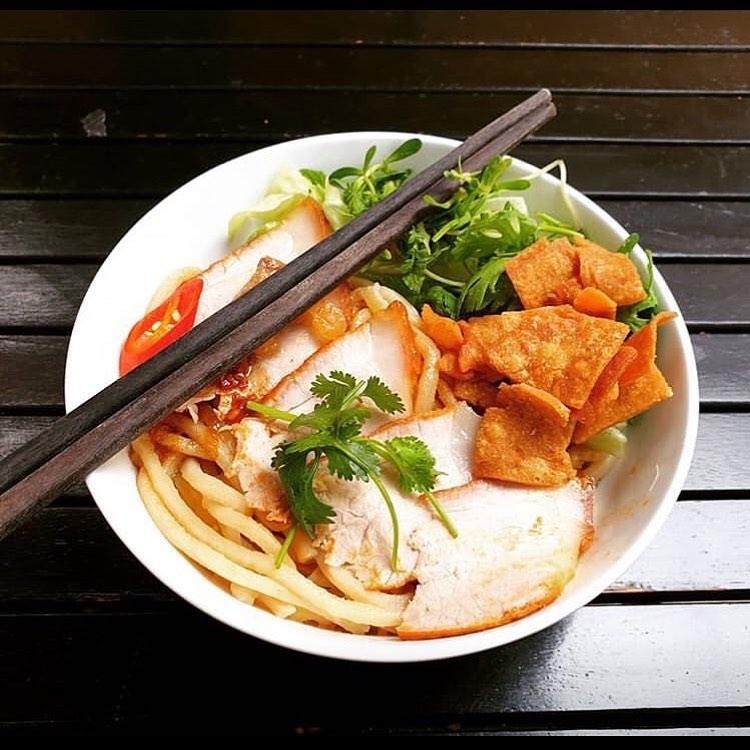 Close-up of cao lầu's firm, square-cut noodles and crispy fried squares.
A third idea goes back even further to the time before foreign traders. Central Vietnam was the land of the Champa kingdom for over a thousand years, and the Cham were highly skilled at building wells. The famous Bá Lễ well used to make cao lầu is widely described as a Cham-era structure, dug centuries before the trading boom. Some take this as a hint that the noodle, or at least its water source, predates the 16th-century port boom, though that is a leap from a well to a finished dish.
This theory is the most romantic and the least documented. It lives mostly in oral tradition, so treat it as a maybe rather than a fact.
The last theory says everyone is asking the wrong question. Cao lầu is neither Chinese nor Japanese nor Cham. It is purely Hội An. The argument is that the dish is defined by its specific water and its specific wood-ash. Move it somewhere else and it stops being cao lầu, no matter who makes it.
Locals repeat this theory the most often, and it leads straight to the most interesting claim of all.
Ask a Hội An cook and they will tell you flatly that real cao lầu can only be made here. Two ingredients are the reason. You need water from one old well and ash from one island.
Tradition dictates that the noodle dough must be mixed with water from giếng Bá Lễ (Ba Le Well), an old well tucked down an alley off Phan Châu Trinh street in the Old Town. The water is said to be slightly mineral and "sweet." Cooks claim this is what gives the noodles their firmness and their pale color rather than a bright white.
To be clear, this is a tradition that cooks hold to strongly rather than a result printed on a lab report.
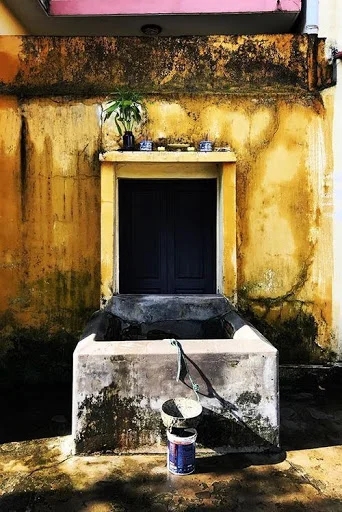 Giếng Bá Lễ, the ancient well whose water is said to give cao lầu noodles their texture.
The second secret is the lye. Traditionally, the rice is soaked in ash water called nước tro. This water is made by burning wood from particular tree species on Cù Lao Chàm (Cham Islands), a cluster of islands about 15 km off the Hội An coast, then leaching the ash through water to draw off the alkaline liquor.
Here is the food science in plain terms. Ash water is alkaline with a high pH. When you add an alkaline solution to a grain dough, it changes the starch and protein so the noodle turns firmer, chewier, springier, and slightly yellow-tan. This is the exact same trick behind ramen, where it is called kansui, and many styles of Japanese udon. The chewy bounce of cao lầu comes from real, repeatable chemistry.
It is half true in the most interesting way.
The chemistry is real. Alkaline water plus ash lye genuinely produces a chewy, pale, springy noodle. You could reproduce that part anywhere. What remains unproven is the stronger claim that it must be this exact well and this exact island, and that no water anywhere else will do. That part is local pride. It is a great tradition to respect, but a lab has never confirmed it.
Most famous Vietnamese dishes traveled. Phở went north to south and then around the world. Bún chả and bánh mì are everywhere. Cao lầu mostly stayed home. Because its identity is tied so tightly to local water and ash, and because making the noodles is highly tedious, it never scaled up into a national street food.
You can find it in Da Nang. A few great spots are run by Hội An families who bring the noodles or the know-how with them. Just be a little careful. The further you get from Hội An, the more often a bowl labeled "cao lầu" is an imitation made with the wrong noodle. When in doubt, eat it in Hội An itself or at a Da Nang place with a clear Hội An connection.
You do not need to be an expert. Just use this quick checklist:
If your bowl ticks those boxes, you have the real thing.
We are not going to list restaurants here. For actual addresses, prices, and our honest picks for where to eat cao lầu in Hội An and Da Nang, see our full cao lầu where-to-eat guide. If you are mapping out a wider eating trip, our honest Da Nang food guide puts cao lầu in context with everything else worth trying.
What does "cao lầu" mean? It is usually traced to Chinese and read as "high floor" or "upstairs." The usual story is that well-off merchants in old Hội An ate the dish on the upper floor of riverside shophouses, where they could catch the breeze and watch the street below.
Is cao lầu Chinese or Japanese? It is probably a bit of both, combined with local Hội An know-how. The seasoning (char siu, soy sauce) leans Chinese, while the thick, chewy, square noodle reminds many people of Japanese udon. There is no proof of a single inventor. It grew out of a port where many cultures mixed.
Why can it only be made in Hội An? Tradition says the noodles need water from the Bá Lễ well and ash lye from Cù Lao Chàm island. The chemistry is real, as alkaline water makes a chewier, paler noodle. However, the idea that it must be that exact well and island is local tradition rather than a proven fact.
How old is cao lầu? It is likely a few hundred years old, generally tied to Hội An's busy trading era from the 16th through 18th centuries. There is no firm birth year on record. Like a lot of old street food, it almost certainly formed slowly over time rather than being invented on a single day.
Is cao lầu the same as mì quảng? No. They look similar, but mì quảng has bright yellow turmeric noodles and a little more broth. Cao lầu has pale tan, denser noodles and almost no broth. See our mì quảng guide for a side-by-side comparison.
Cao lầu carries a Chinese seasoning, a Japanese-looking noodle, a possible Cham-era well, and a wood-ash trick based on local chemistry. You can argue about who invented it forever. The better move is to go to Hội An, sit upstairs, and taste 400 years of trade history in a single bowl.

One local roundup a month — new guides, festival dates and where to eat. No spam.